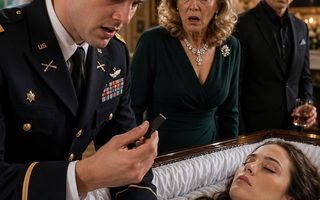
Chapter 1: The Valuation of Silence
The concrete apron of the Grand Vane Hotel smelled intensely of baked tar, ozone, and sulfurous exhaust fumes idling from a fleet of low-slung luxury sedans. It was mid-afternoon, and the heat radiated from the flagstones with a physical weight that made breathing feel like an act of inhalation through a woolen blanket. Silvio’s knuckles throbbed from the impact against Grant’s jaw, but the physical sting was nothing compared to the cold iron settling in his chest.
“They locked us up because I said I was hungry,” little Mia whispered again, her voice cracking with the dry, rasping timbre of someone who had spent hours crying in an unventilated enclosure.
Silvio didn’t look down at her. He couldn’t. If he looked at her smudged face—streaked with a mixture of dust and dried tears—his hands would find Grant’s throat and finish what the valet kiosk had started. Instead, he kept his eyes locked on his brother-in-law, who was currently hoisting himself up from a chaotic sprawl of white ticket rolls, shredded cardboard, and splintered teak wood.
Grant spat a glob of bright crimson onto the pristine flagstones, wiping his mouth with the back of an expensive French-cuffed sleeve. His expression, usually sculpted into the smooth, frictionless mask of a hedge-fund partner who spent his weekends playing polo, had cracked open to reveal something small, slick, and panicked.
“You’re making a scene, Silvio,” Grant panted, his chest heaving beneath his linen blazer. “You always did lack the temperament for corporate discretion. This is a private family matter handled according to domestic protocols. Those children—”
“Those children are my sister’s orphans,” Silvio cut through the voice, his tone flat, dangerous, and entirely devoid of inflection. “And you kept them in the walk-in pantry of the East Wing without water for thirty-six hours because they asked for bread.”
Lucinda pushed herself up from the wreckage of the brochure stand, estate maps fluttering around her silk-stockinged ankles like dying butterflies. Her hair, usually an immaculate, lacquered chignon, had unraveled into a damp fringe across her forehead. She didn’t look chastised; she looked inconvenienced, like a woman whose flight had been delayed by thirty minutes due to minor mechanical issues.
“Don’t be dramatic, Silvio,” Lucinda snapped, shaking a crumpled segment of a resort brochure off her skirt. “The staff was fumigating the west wing nursery. It was an administrative oversight. Grant was simply managing the logistics while we finalized the probate paperwork with the trust attorneys.”
Silvio took a measured, heavy step forward. The two bodyguards who had stepped out from the shadows of the portico—men in identical charcoal suits that looked ridiculous in the sweltering heat—shifted their weight, their hands hovering near their waistbands where heavy composite batons were clipped.
“Logistics,” Silvio repeated softly. He turned his head slowly to look at Grant. “When you walked out of that air-conditioned lobby three minutes ago, your very first words weren’t ‘Are the children hurt?’ or ‘Thank God they’re safe.’ You looked at two starving, dehydrated kids who have more legal claim to the Vane Estate than either of us, and you smirked. You asked: ‘They’re still alive?’”
The silence that fell over the portico was absolute, broken only by the distant, rhythmic ticking of a cooling radiator on one of the idling Mercedes SUVs.
Grant’s eyes flicked sideways toward the bodyguards. It was a micro-expression of betrayal, a momentary lapse in calculation that confirmed every dark, rotting suspicion Silvio had nursed since the day their father’s coffin had been lowered into the permafrost of the family plot.
“Get in the car, Lucinda,” Grant muttered, his voice dropping an octave.
“No one is getting in any car,” Silvio said, his fingers curling into fists once more. “The police are five minutes away. And when they get here, we’re going to open up the safe in the main library. Not to look at the will you filed, Grant. We’re going to look at the addendum Arthur Vane signed forty-eight hours before his heart stopped beating—the one where he named these two children as the primary beneficiaries of the entire holding.”
Lucinda let out a short, sharp laugh that sounded like dry glass breaking. “Arthur was senile, Silvio. He didn’t know what he was signing. He thought the nurse was his third wife.”
“He knew,” Silvio said, his voice dropping into a register that made the nearest bodyguard take an involuntary half-step back. “And that’s why you locked the pantry door.”
Chapter 2: The Probate Paperwork
The conference room of Vane, Sterling & Cross smelled of old leather, floor wax, and the quiet desperation of three generations of dying fortunes. Situated on the top floor of a limestone tower overlooking the financial district, the room featured floor-to-ceiling windows that captured the gray sprawl of the city stretching out toward the industrial harbor.
Arthur Vane had built his empire on municipal bonds, aggressive zoning acquisitions, and a ruthless refusal to ever give back a square inch of land once his name was on the deed. But empires rot from the inside out, and by the time his heart gave out on a Tuesday morning in October, the Vane estate was less a dynasty and more a contested legal battleground.
Silvio sat at the far end of the mahogany table, his forearms resting on the cool wood. Across from him sat Marcus Vance—no relation, despite the phonetic irony—the senior partner who had managed Arthur’s legal affairs since the Nixon administration. Marcus looked like a man who had been embalmed twenty years ago and forgotten in a broom closet; his skin had the dry, yellowish hue of parchment left too long in the sun.
“The document you’re waving around, Silvio, is procedurally irregular,” Marcus said, adjusting a pair of tortoiseshell half-moons on the bridge of a sharp, beak-like nose.
“Irregular,” Silvio echoed. He slid a crisp, heavily watermarked sheet of paper across the polished grain. “It’s signed, notarized by a licensed public officer in three separate counties, and accompanied by a video deposition recorded on Arthur’s iPad forty-eight hours before he died. That’s not irregular, Marcus. That’s airtight.”
Grant, sitting to the right of the old lawyer with a strip of white surgical tape running along his jawline where Silvio’s fist had connected, leaned forward with a calculated sneer.
“An old man medicated to the gills with morphine and oxycodone does not possess testamentary capacity, Silvio. Any probate judge in the state would toss that out before lunch. Arthur didn’t even know what year it was. He thought the gardener was his brother.”
“He knew who Ethan and Mia were,” Silvio countered without blinking. “He knew they were his true bloodline—the grandchildren he was forced to abandon when Lucinda and you manufactured that smear campaign against our cousin Julian twenty years ago.”
Marcus raised a frail, liver-spotted hand, cutting off the impending shouting match with a single, weary gesture. “Let’s not relitigate family tragedies from the past century. The issue before this firm is the legal disposition of the Vane Holdings trust, specifically the real estate portfolio comprising forty-two commercial properties and the residential estate in Old Mill Ridge. As the primary executors appointed under the 2014 Primary Instrument, Lucinda and Grant hold operational control.”
“Operational control,” Silvio said, his voice dangerously low, “does not include starving minors in a walk-in pantry to force an abandonment of their inheritance claims.”
Lucinda, who had spent the last ten minutes filing her fingernails with a small emery board, finally looked up. Her eyes were hard, flat agates.
“Those children are bastards, Silvio. They are the offspring of a disgraced runaway and some nameless drifter from the coast. They have no place in this family, and they certainly have no legal standing to inherit property that was built on forty years of my father’s sweat and my husband’s financial acumen.”
“Your husband’s financial acumen,” Silvio repeated, a humorless smile touching the corners of his mouth, “consists of three failed hedge funds, two federal investigations that were mysteriously dropped after Arthur paid off a state senator, and a mountain of gambling debts in Macau that are currently being called in by men who don’t send lawyers when bills go unpaid.”
Grant’s face drained of what little color the heat had left in it. He stood up so fast his mahogany chair tipped backward, crashing onto the deep-pile oriental rug with a dull thud.
“You watch your mouth, you sanctimonious prick,” Grant hissed, rounding the table. “You’ve spent the last ten years living in a cabin in Vermont pretending to be a painter while the rest of us kept this family from drowning in debt. You don’t know anything about the cash flow required to keep these properties afloat!”
“I know enough to know that you mortgaged the Old Mill Ridge estate three weeks before Arthur died using a forged power of attorney,” Silvio said softly, standing up to meet him eye-to-eye.
The room went dead silent. Marcus Vance slowly lowered his half-moon glasses, his watery eyes narrowing as he looked from Grant to Lucinda.
“Is that true, Grant?” the old lawyer asked, his voice cracking slightly.
Grant didn’t answer. He just stared at Silvio with a look of pure, unadulterated murderous intent.
Chapter 3: The Ghost of Old Mill Ridge
Old Mill Ridge sat on a jagged granite bluff overlooking the slate-gray swells of the Atlantic, five miles north of the city limits. The house itself was a sprawling, melancholic leviathan of gray stone, slate roofs, and weeping copper beeches that scraped against the third-floor windows whenever an ocean gale swept inland.
Silvio parked his battered Subaru station wagon right beside the marble fountain where the water had long since turned into a stagnant, green-tinted soup of fallen leaves and dead insects. Ethan and Mia sat in the back seat, their small faces pressed against the cold glass, staring up at the gothic arches of the mansion with wide, fearful eyes.
“We aren’t going back in that box, Uncle Silvio, are we?” Mia asked, her small fingers clutching the frayed hem of her oversized sweater.
Silvio turned around in his seat, offering them a gentle, reassuring smile that felt entirely foreign to his face.
“No, pumpkin. Never again. Nobody is ever putting you in a pantry, a closet, or anywhere else. Today, we’re taking the house back.”
He killed the engine, got out, and walked around to open the rear doors. The salt air hit him immediately, smelling of rotting kelp and wet stone. It was the same smell that had haunted his childhood—a place where love was measured in square footage and emotional warmth was treated as a structural weakness.
As they walked up the broad granite steps toward the double oak doors, the heavy brass knocker seemed to sneer down at them. Silvio didn’t bother knocking; he reached into his jacket pocket, pulled out the heavy brass master key Arthur had slipped into his palm during their final, desperate meeting at the hospice, and slid it into the lock.
The mechanism turned with a satisfying, heavy clack, and the door swung inward, revealing a grand foyer dominated by a sweeping spiral staircase of dark walnut.
“Uncle Silvio?” Ethan whispered, pointing toward the eastern corridor. “That’s where they kept us. Through the double doors behind the butler’s pantry.”
Silvio’s jaw tightened. He walked straight past the sweeping staircase, his boots echoing sharply on the parquet flooring. The house felt hollow, abandoned by its own history. The paintings on the walls—stern-faced ancestors who had made fortunes in shipping and timber—seemed to gaze down with silent disapproval.
When he reached the door to the walk-in pantry, he didn’t hesitate. He raised his boot and drove his heel hard against the lock-plate. The old brass fitting splintered with a sharp crack, and the heavy door swung wide open, spilling weak afternoon light into the cold, windowless chamber.
Inside, the space was precisely as they had described: rows of empty steel shelving, a single plastic bucket in the corner, and a faint, stale odor of old dust and fear. On the bottom shelf sat a half-eaten crust of dry bread and a plastic cup with a thin film of greenish water at the bottom.
Silvio felt a cold fury settle deep into his bones—a steady, white-hot clarity that wiped out every doubt, every hesitation, and every lingering shred of family loyalty.
“They treated you like animals,” Silvio murmured, kneeling down to touch the cold concrete floor where his niece and nephew had shivered for thirty-six hours. “Because they were terrified you were going to take what they stole.”
“Are they going to jail, Uncle Silvio?” Ethan asked, standing in the doorway with his small hands stuffed deep into his pockets.
Silvio stood up, turned around, and looked down at the two children who represented everything his family had tried to crush, bury, and starve out of existence.
“Not yet, buddy,” Silvio said, a hard, humorless smile touching his lips. “First, we’re going to let them think they won. And then, we’re going to dismantle their entire world piece by piece.”
Chapter 4: The Neighborhood Whispers
Old Mill Ridge was not just a house; it was a gated ecosystem of wealth, privilege, and institutionalized silence. In neighborhoods like this, people didn’t call the police when they heard children crying for hours through thick masonry walls; they simply turned up the volume on their Bang & Olufsen sound systems and poured another glass of crisp Sauvignon Blanc.
But whispers, like water through hairline cracks in a foundation, eventually found their way to the surface.
Two days after the confrontation at the Grand Vane Hotel, Silvio sat on a weathered wooden bench at the edge of the neighborhood marina, watching the multimillion-dollar yachts bob lazily against their moorings. Beside him sat Mrs. Gable, an octogenarian widow who had lived in the adjacent estate since the Eisenhower administration and knew every skeleton buried within a three-mile radius.
“Arthur knew what they were doing toward the end, you know,” Mrs. Gable said, her voice a dry, papery rattle as she adjusted her oversized sunglasses against the glare off the water. “The old man wasn’t as far gone as the doctors pretended. Lucinda had him heavily medicated, of course—she didn’t want him talking to the estate lawyers without her sitting right there in the corner like a vulture.”
Silvio kept his eyes on a sleek forty-foot sailboat cutting across the harbor. “He told me they were draining the accounts to cover Grant’s gambling losses in Macau. But I didn’t realize the extent of it until Marcus Vance showed me the ledger extracts this morning.”
“Extents?” Mrs. Gable let out a dry, hacking chuckle. “Grant didn’t just gamble in Macau, Silvio. He was using the Vane family trust as collateral for high-interest bridging loans from private equity syndicates with ties straight out of the eastern seaboard underworld. If those loans aren’t paid off by the end of the month, every single commercial property your grandfather built will be seized by men who don’t bother with courtrooms.”
Silvio turned his head slowly to look at her. “And Lucinda?”
“Lucinda?” The old woman snorted. “Lucinda has been planning her exit strategy since the day she married him. She has three offshore accounts registered in the Caymans under a shell corporation called Vane-Garrity Holdings. She knew Grant was running the ship aground, and she was planning to grab whatever liquid assets remained and leave him holding the bag when the creditors finally came knocking.”
“Which explains why they were so desperate to get rid of Ethan and Mia,” Silvio said, the pieces clicking together with mathematical precision. “If my cousins—legitimate heirs under Arthur’s final addendum—inherit the estate free and clear, the trusts are locked down. Grant can’t use them as collateral, and Lucinda can’t loot them for her offshore retirement fund.”
“Precisely,” Mrs. Gable whispered, leaning closer. “And they thought nobody would notice two little orphans disappearing from the guest wing. In a place like this, kids who don’t belong to the country club set might as well be ghosts.”
Silvio stood up, brushing a few grains of sand from his trousers. He looked back toward the sprawling silhouette of Old Mill Ridge rising above the tree line against the gray coastal sky.
“They aren’t ghosts anymore, Mrs. Gable,” Silvio said softly. “And neither is the truth.”
Chapter 5: The Midnight Audit
The offices of Vane Holdings after midnight possessed the cold, mausoleum-like stillness of a tomb. The cleaning crew had come and gone at ten, leaving behind the faint smell of lemon-scented disinfectant and the low, monotonous hum of the commercial HVAC system pumping climate-controlled air through empty corridors.
Silvio moved through the executive suite like a shadow, his rubber-soled boots making no sound on the imported Turkish carpets. He didn’t need to break in; Arthur had given him the physical brass key to the private wall safe hidden behind a nineteenth-century oil painting of a clipper ship in the boardroom.
He reached up, swung the heavy gilded frame outward, and revealed the brushed-steel keypad set flush into the oak paneling. He punched in Arthur’s birth date followed by the numerical code for the year the shipping line was founded.
Click.
The heavy steel door swung open smoothly, revealing a neat stack of leather-bound ledgers, a cache of old family photographs, and a thick manila envelope marked in bold, red marker: FOR SILVIO’S EYES ONLY – THE TRUTH ABOUT OLD MILL RIDGE.
Silvio pulled the envelope out, set it down on the boardroom table, and began turning the pages under the harsh glare of a single desk lamp.
Inside were not just financial statements, but handwritten journals, bank transfer receipts, and signed affidavits from former household staff who had been fired, paid off, or threatened into silence over the past decade. There were records of millions of dollars siphoned out of the municipal bond accounts and funneled directly into anonymous offshore entities controlled jointly by Grant and Lucinda.
And right there, tucked into the back pocket of the folder, was the missing link: a notarized transcript of a conversation recorded on a micro-cassette player three months before Arthur died.
Grant’s voice: “If the old man doesn’t sign the transfer over to our shell company by Friday, we’ll have to find another way to handle the kids.” Lucinda’s voice: “They’re just kids, Grant. People lose track of orphans all the time in the city system.” Grant’s voice: “Not these kids. Silvio’s sniffing around. If he finds them, the whole scheme unravels. We need them out of the picture permanently.”
Silvio stared at the paper, his breath catching in his throat. They hadn’t just locked Ethan and Mia in the pantry as a cruel disciplinary measure; it was a dry run for an elimination protocol. If the children had stayed in that unventilated room for another twenty-four hours in the July heat, dehydration and heatstroke would have finished the job quietly, leaving Grant and Lucinda free to claim the children had run away or died of natural causes during a domestic emergency.
“You bastards,” Silvio whispered into the empty boardroom.
Suddenly, the heavy oak doors at the end of the suite clicked open. A beam of white light cut across the dark carpet.
“I told you someone was up here,” a smooth, slightly panicked voice echoed down the hall.
It was Grant. And from the heavy, unsteady sound of his footsteps, he wasn’t alone.
Chapter 6: The Trap Springs
Silvio didn’t panic. He calmly slid the manila envelope inside his heavy canvas satchel, zipped it shut, and stepped backward into the shadows behind the towering mahogany bookcase that lined the eastern wall of the boardroom.
The door pushed open fully, and Grant stepped into the room, holding the high-powered flashlight of his smartphone beam steady. Close behind him was one of his corporate bodyguards—a hulking, thick-necked individual named Miller who had a broken nose and a reputation for handling dirty work in the shipping yards.
“Check the safe,” Grant snapped, his voice tight with adrenaline. “If he took the Cayman ledgers, we’re finished. The SEC will have our assets frozen before the markets open on Monday.”
Miller stepped up to the open wall safe, flashing the light inside. He ran a heavy, calloused hand over the empty steel interior.
“It’s empty, Mr. Garrity,” Miller grunted, his voice sounding like gravel grinding in a cement mixer. “The whole file is gone.”
Grant slammed his fist against the edge of the mahogany table, cursing under his breath. “I knew we should have dealt with Silvio permanently back at the hotel. He’s like a cockroach—you step on him, and he just keeps crawling back out of the woodwork.”
“You won’t have to worry about me crawling much longer, Grant,” Silvio said, stepping out from the shadows of the bookcase into the pool of desk lamp light.
Grant spun around so fast he nearly tripped over his own designer loafers. Miller’s hand instantly flashed toward his waistband, but Silvio was already holding something that made the bodyguard freeze mid-motion: a compact digital recorder resting casually in his palm, its red recording indicator blinking steadily.
“Everything you just said,” Silvio said evenly, “including your admission about wanting to eliminate the children and your panic over the Cayman accounts, is currently streaming live to a secure cloud server monitored by federal investigators and three separate investigative journalists.”
Grant’s face turned the color of spoiled milk. For a second, he looked like he might vomit. All the aristocratic polish, the tailored linen, and the corporate swagger evaporated, leaving behind a terrified, cornered man scrambling for a way out.
“You’re bluffing,” Grant whispered, though his voice lacked any conviction. “You don’t have a signal up here on the forty-second floor. This building is a Faraday cage.”
“Maybe,” Silvio replied, stepping closer, his eyes fixed on his brother-in-law with an intensity that made Miller instinctively take a defensive step back. “But even if I am, the copies are already sitting in the inbox of the U.S. Attorney’s office, timed to release automatically if I don’t check in by sunrise.”
Miller looked sideways at Grant, his professional detachment slipping away. “Mr. Garrity… nobody said anything about federal investigations. My contract was for security consulting, not accessory to corporate fraud and child endangerment.”
“Shut up, Miller!” Grant screamed, losing control entirely. “Take him down! Take the bag and break his phone!”
Miller didn’t move. He looked at Silvio, then at Grant, and slowly unclipped the heavy composite baton from his belt, letting it slide soundlessly onto the carpeted floor.
“I’m out,” Miller said flatly. He turned on his heel and walked out of the boardroom without looking back.
Chapter 7: The Meta Leak
Within twelve hours of the midnight confrontation at the corporate tower, the digital landscape shifted beneath the feet of the Vane family empire like an earthquake tearing through sand.
It didn’t start on the front page of the Wall Street Journal; it started on Meta—specifically through a series of synchronized, hyper-targeted video drops posted by an anonymous whistleblower account titled The Vane Files.
The first post was a three-minute compilation video: security camera footage from the Grand Vane Hotel showing Grant smirking when told about the starving children, interspersed with audio clips from the midnight boardroom confrontation where Grant and Lucinda openly discussed locking Ethan and Mia in the pantry as a permanent solution to their inheritance claims.
Within four hours, the video had crossed two million views. By hour six, it was trending globally under the hashtag #TheLockedInheritance and #VaneFamilyScandal.
Silvio sat at the kitchen table of his modest suburban safehouse, watching the view counter spin upward in real time on his laptop screen. Ethan and Mia sat across from him, eating bowls of cereal with a sense of security they hadn’t felt in years.
“Uncle Silvio,” Mia asked, pointing at the phone screen where thousands of comments were scrolling past at lightning speed. “Are all those people angry at Aunt Lucinda?”
“They’re asking questions, pumpkin,” Silvio said gently, reaching across the table to brush a stray curl from her forehead. “And when people start asking the right questions in public, powerful people can’t hide behind closed doors anymore.”
The phone on the table buzzed violently. It was an unknown number with a Washington, D.C. area code.
Silvio picked it up and pressed accept.
“Mr. Vane?” a crisp, professional voice asked. “This is Special Agent Vance from the Federal Bureau of Investigation’s White-Collar Crime Division. We’ve reviewed the materials uploaded via your secure portal this morning. Based on the financial records, the audio depositions, and the witness affidavits regarding the confinement of minors, federal warrants have just been issued for the arrest of Grant and Lucinda Garrity.”
“Are they in custody?” Silvio asked, his voice steady.
“State troopers picked them up ten minutes ago trying to board a private charter flight at the municipal airfield,” the agent replied. “They were carrying three passports each and two duffel bags stuffed with bearer bonds and cash. They won’t be leaving the jurisdiction anytime soon.”
Silvio let out a long, slow breath—a breath he felt like he had been holding since the day his grandfather’s coffin was lowered into the ground.
“Thank you, Agent. Let me know when the arraignment is scheduled.”
Chapter 8: The Courtroom Reckoning
The federal courtroom in the downtown municipal district was packed to the gills. Reporters, financial bloggers, neighborhood residents from Old Mill Ridge, and curious onlookers spilled out of the wooden benches and lined the walls three deep. Flashbulbs popped outside the tall arched windows like distant summer lightning.
Grant and Lucinda sat at the defense table, flanked by two high-priced corporate defense attorneys who looked like they were already calculating their hourly billing rates for a lost cause. Lucinda stared straight ahead, her face frozen in a mask of haughty defiance, refusing to look at the gallery. Grant kept his head down, staring obsessively at a yellow legal pad where he had been scribbling frantic notes for the past hour.
Silvio sat in the front row of the public gallery, with Ethan on his left and Mia on his right. Both children wore neat, brand-new clothes purchased the day before—a small, tangible symbol of a new life that could no longer be stolen from them.
The heavy oak doors at the front of the chamber swung open, and the bailiff’s voice rang out with theatrical resonance:
“All rise for the Honorable Judge Elizabeth Sterling.”
The judge entered—a formidable woman with silver hair cropped short and eyes that missed nothing—and took her seat behind the high mahogany bench.
“Please be seated,” Judge Sterling said, her voice dry and authoritative. She adjusted her reading glasses and looked down at the massive stack of documents arrayed before her. “We are here for the emergency arraignment and custody confirmation in United States v. Garrity et al., as well as the probate validation petition concerning the Vane Holdings Trust.”
For the next two hours, the courtroom became a clinic in systematic dismantling. Assistant U.S. Attorney Vance laid out the charges with surgical precision: wire fraud, interstate laundering of corporate assets, forgery of legal instruments, conspiracy, and felony child endangerment.
When the prosecution played the unedited audio recording of Grant and Lucinda discussing the children in the walk-in pantry, a collective gasp rippled through the packed gallery. Several reporters furiously typed notes, while a murmur of disgust rolled across the wooden benches.
Lucinda’s defense attorney stood up, his face pale. “Your Honor, while the audio recording reflects regrettable domestic friction, the charges of child endangerment are vastly overstated. The children were merely placed in a secure holding area during a fumigation process—”
“Counsel,” Judge Sterling interrupted, her voice dropping to a temperature just above freezing. “Do not insult this court’s intelligence. A walk-in pantry without ventilation or water during a July heatwave is not a fumigation protocol; it is a detention cell used to coerce minors into forfeiting their legal inheritance.”
The attorney sat down abruptly, smoothing his tie with a trembling hand.
Judge Sterling turned her gaze from the defense table directly toward Silvio and the two children sitting in the front row. Her stern expression softened by a fraction, revealing a profound, human gravity behind the judicial robe.
“Before I issue my final ruling on the probate trust,” Judge Sterling said clearly, “the court has received a notarized petition from the court-appointed guardian ad litem recommending the immediate transfer of operational control of the Vane Estate to Silvio Vane, alongside full permanent guardianship of Ethan and Mia Vane.”
She picked up her heavy wooden gavel, paused for a fraction of a second, and brought it down with a sharp, echoing crack.
“So ordered. All emergency asset freezes on the Vane Holdings trust are lifted, effective immediately, pending full reallocation to the primary beneficiaries. Court is adjourned.”
Chapter 9: Neighborhood Revelations
The sun was setting over Old Mill Ridge, casting long, amber shadows across the manicured lawns and stone facades of the elite coastal enclave. But the atmosphere in the neighborhood had fundamentally changed. The polite, icy silence that had protected decades of family corruption and domestic cruelty had been permanently shattered.
As Silvio’s Subaru pulled up the circular gravel drive of the grand estate, a small crowd of local residents stood near the entrance gates. They weren’t holding picket signs or cameras; they were simply watching—a silent, collective acknowledgment that the dynasty had changed hands.
Mrs. Gable stood near the foot of the granite steps, leaning slightly on her polished brass cane. As Silvio stepped out of the car, she offered him a slow, approving nod.
“Welcome home, Silvio,” she called out across the lawn. “The neighborhood is going to be a lot quieter now that the vultures are behind bars.”
Silvio smiled faintly, walking around to open the back doors for Ethan and Mia. The children tumbled out onto the gravel, no longer walking with the timid, cowering gait of captives, but running freely across the lawn toward the massive oak trees where the late afternoon light caught the leaves like gold leaf.
“Are we really going to live here forever, Uncle Silvio?” Ethan shouted back over his shoulder, his face bright with laughter.
“Forever and a day, buddy,” Silvio called back, watching them race toward the garden where the old fountain was already being drained of its stagnant water by a crew of local contractors he had hired that morning.
He walked up the broad stone steps, unlocked the heavy oak doors, and pushed them wide open. The interior of the house no longer smelled of old dust, fear, and institutional decay. With the windows thrown open to catch the fresh salt breeze rolling in off the Atlantic, the grand foyer smelled of pine, salt air, and uncomplicated possibility.
Arthur’s portrait still hung at the top of the grand staircase, the old man’s stern eyes catching the fading sunlight. But as Silvio looked up at him, the old shipping magnate no longer looked like a tyrant presiding over a crumbling empire. He looked like an old man who had finally found someone strong enough to carry the weight.
Chapter 10: The Unbroken Line
Six months later, the municipal records office officially recorded the complete dissolution of Vane-Garrity Holdings and the full transfer of the Old Mill Ridge estate into the independent educational and residential trust established for Ethan and Mia Vane.
Grant and Lucinda sat in a federal penitentiary three hundred miles inland, waiting out multi-decade sentences for white-collar fraud and child endangerment—their high-society friends long since having deleted their phone numbers and pretended they had never met them at the country club.
Back at Old Mill Ridge, the stone mansion was alive with a kind of noise it hadn’t heard in half a century: the sound of children laughing in the hallways, doors unlocked, music playing from the kitchen, and a profound, unshakable peace settling into the marrow of the old walls.
Silvio sat on the wide stone terrace overlooking the gray expanse of the ocean, a sketchpad resting on his knees and a graphite pencil in his hand. He wasn’t painting grand, sweeping landscapes of corporate power anymore; he was sketching two small figures running along the shoreline against the backdrop of a breaking wave.
Footsteps crunched softly on the flagstones behind him. Mia walked up, holding a glass of iced lemonade in one hand and a freshly picked wildflower in the other.
“Uncle Silvio? Are you coming inside for dinner? Mrs. Gable sent over a peach cobbler.”
Silvio lowered his pencil, looked down at his niece, and smiled—not with the defensive hardness of a man bracing for a fight, but with the warm, open expression of someone who had finally finished building a home.
“Tell Mrs. Gable we’ll be right there, pumpkin,” Silvio said, standing up and taking her small hand in his. “We’re just finishing up here.”
They turned together, walking away from the cliff edge and toward the warm, glowing light streaming through the open kitchen doors of a house that finally belonged to the living.